Every question we are asked about Pena, in alphabetical order. Open one to read the answer in place.
Are dogs allowed at Pena Palace?
Small dogs on a lead are permitted in the park; they are not permitted inside the palace interior. Visitors with assistance dogs are admitted throughout. Water bowls are not standard on the route — bring your own if visiting in summer.
Are there food and drink options at Pena?
Yes. There is a café and a restaurant on the palace level near the entry, and a second smaller café in the lower park. Both can be busy at peak lunch hours and are not gastronomic destinations. Many visitors prefer to eat before or after their Pena visit in Sintra town, which has a denser concentration of restaurants. Water fountains are available in the park; bringing a refillable bottle is sensible.
Can I bring a buggy or stroller into Pena Palace?
Into the park, yes, though the paths are steep in places. Into the palace interior, in practice no — the one-way route includes several stair flights and narrow passages. Parques de Sintra provides a buggy parking area near the palace door. A soft baby carrier is the right choice for the interior with infants.
Can I change my date or time?
Once booked, slots are non-transferable and non-refundable. If you need to change, contact us at bookings@palaciopena.com — we'll help where we can, but cannot guarantee a new slot, especially in peak season.
Can I drive to Pena Palace?
No, not to the palace itself. The upper Serra road has been closed to private vehicles since 2022. Independent visitors park at one of the lower-mountain car parks and use Parques de Sintra shuttle, the 434 hop-on bus, or a pre-arranged transfer to reach the palace gate. Private transfers can drop and collect at the main entrance even though general traffic cannot.
Can I see the inside of the Chapel at Pena?
Yes, on the Palace + Park ticket. The chapel is the oldest part of the complex — the original 16th-century structure dedicated to Nossa Senhora da Pena that survived the 1755 earthquake — and is reached early on the one-way interior route. It retains its original alabaster altarpiece and is still consecrated; the operator asks visitors to keep voices low and shoulders covered.
Can I take photographs inside Pena Palace?
Yes, in most rooms, without flash. A small number of rooms — typically those with delicate textiles or recently conserved decorative paintwork — prohibit photography entirely; these are marked with signage at the door. Tripods are not permitted inside. Drones are prohibited across the entire Sintra Cultural Landscape, including the park.
Can I visit Pena Palace without going inside the rooms?
Yes. The Park-only ticket admits you to the gardens and the exterior terraces around the palace — including all the main photo positions — but not into the interior. It is the right choice if your priority is photography and landscape rather than the rooms and royal history. We default first-time visitors to the Palace + Park ticket because the interiors are unusual; see the ticket section above.
How busy does Pena get?
Very busy. Pena receives several million visitors per year and on summer Saturdays the upper park can feel crowded between 11:30 and 15:00. The reliable mitigations are a first-slot interior ticket (09:30–10:00 in most seasons), midweek visits, off-season visits between November and February (when the mist is most reliable and the park is at its emptiest), and avoiding days when multiple cruise ships are docked in Lisbon. Our /guides/best-time-to-visit/ page covers cruise-day patterns in detail.
How do I get to the Pena Palace?
The Pena Palace sits above the town of Sintra, around 30 kilometres north-west of Lisbon. The easiest approach is by train: frequent services run from Lisbon's Rossio station to Sintra in roughly 40 minutes, and from Sintra station the circular 434 tourist bus climbs the hill to the palace, also calling at the Moorish Castle on the way. The bus takes about 15 minutes, though queues can be long in peak season. Energetic visitors can instead walk up through the Park of Pena, a steep climb of some 30 to 40 minutes from the historic centre. By car, Pena is roughly 40 minutes from Lisbon, but parking near the entrance is very limited and the narrow hillside roads become congested in summer. From the main gate there is a further uphill walk, or a short shuttle, to reach the palace doors themselves.
How does Pena Palace compare to the Moorish Castle on the next ridge?
The two sit on neighbouring ridges about a 20-minute walk apart and complement each other rather than compete. The Castelo dos Mouros, or Moorish Castle, is a partially restored 8th- to 9th-century hill fort, the older site by roughly a thousand years, and it is entirely about walkable ramparts and sweeping panoramas across Sintra and the Atlantic; it has no interior rooms to visit. Pena Palace, by contrast, is a 19th-century Romantic palace whose appeal lies in saturated colour, eclectic revival architecture and richly furnished royal interiors preserved from the day the monarchy fell in 1910. The castle rewards a walk and a view; Pena Palace rewards a slow look at rooms and design. They share a common entry area and the same operator, and most visitors who tackle both in one day climb the Moorish Castle first, when legs are fresh, and finish at Pena Palace, saving the grander spectacle for last.
How long is a typical visit?
Allow 3–4 hours in total: 45–60 minutes inside the palace, 90+ minutes in the park, plus travel to and from the gate.
How long should I plan to spend at Pena Palace?
Plan at least three hours for a Palace and Park visit to Pena Palace, and four to five if you want to see everything unhurried. A realistic breakdown is 60 to 75 minutes inside the palace itself, including the short wait at the timed-entry door and the one-way route through the royal rooms; around 90 minutes wandering the 200-hectare park; and a buffer for the steep 600-metre climb, or the shuttle, up from the lower gate to the palace forecourt. Adding the Chalet of the Countess of Edla in the western park and the 20-minute uphill walk to the High Cross viewpoint pushes the visit towards four or five hours. Families with young children should budget a full five hours and use the internal shuttle bus to save small legs. Because the park is genuinely half a day in its own right, rushing Pena Palace is the main regret most visitors report.
Is it suitable for children?
Yes — kids generally love the fairytale exterior, the dungeons, and the cannons. Strollers are tough on the cobbles; a shuttle from the gate helps.
Is Pena Palace UNESCO World Heritage?
Yes. Pena is the centrepiece of the Cultural Landscape of Sintra, inscribed on the UNESCO World Heritage list in 1995. The designation covers the wider Sintra hills landscape and several monuments within it — Pena, the Moorish Castle, the National Palace of Sintra in the town, the gardens of Monserrate, and the Capuchos Convent — as a coherent Romantic-era cultural landscape.
Is Pena Palace wheelchair accessible?
Partially. Parques de Sintra operates an internal shuttle from the lower park gate to the palace forecourt that is wheelchair-accessible. The exterior terraces around the palace are mostly accessible. The interior route through the rooms includes several flights of stairs and narrow corridors and is not fully wheelchair-accessible. The Chalet of the Countess of Edla and the High Cross involve unpaved paths and inclines. Parques de Sintra publishes a specific accessibility page on its site, which we recommend any visitor with reduced mobility consult before booking.
Is Pena Palace worth visiting if I only have one day in Sintra?
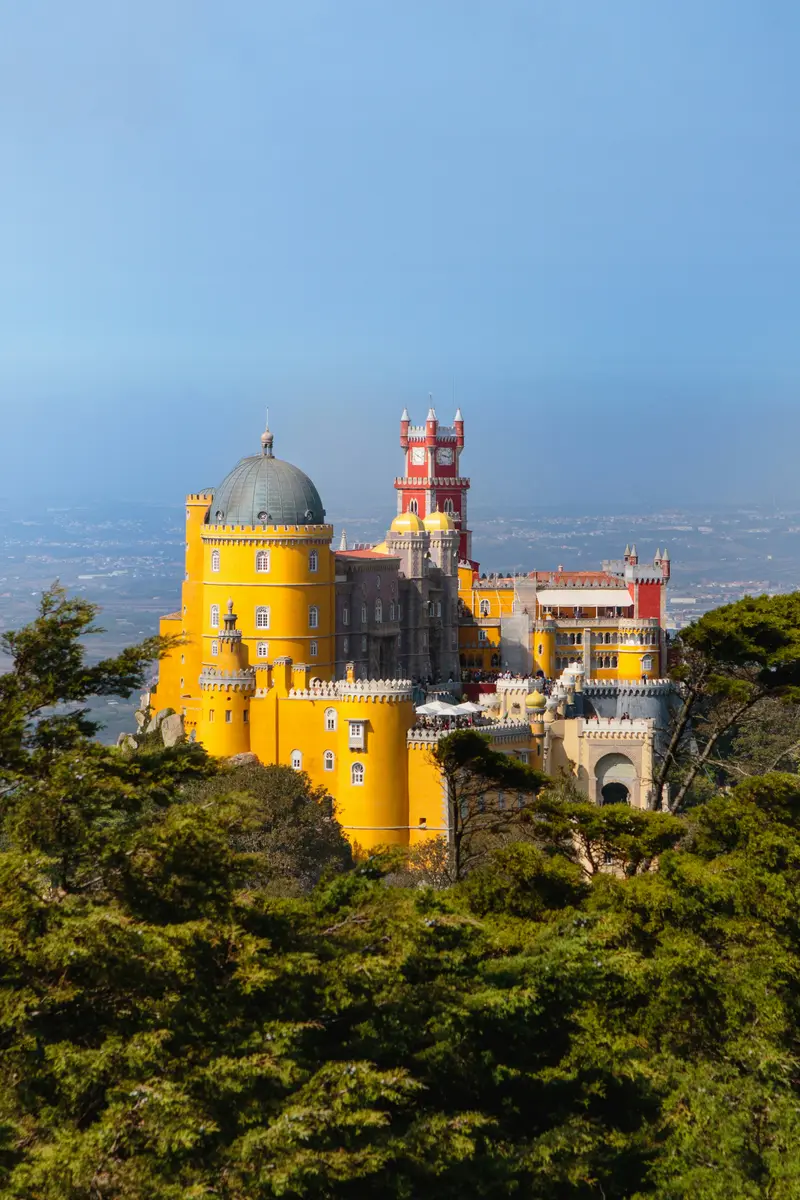
Yes. Pena Palace is the single most distinctive attraction in the Cultural Landscape of Sintra and the one most one-day visitors regret missing. Perched on the highest forested ridge of the Serra de Sintra, its canary-yellow clock tower, vermilion Manueline wing and Moorish battlements make it one of the most photographed buildings in Europe, and the interior preserves the royal apartments almost exactly as the Portuguese royal family left them when the monarchy fell in October 1910. If you have only one day and one site, choose Pena Palace and budget at least four hours including the train and bus from Sintra town. If time allows a second stop, pair it with Quinta da Regaleira for its esoteric gardens and Initiation Well, or the neighbouring 8th-century Moorish Castle for its ramparts and Atlantic views, though attempting all three in a single day leaves most visitors rushed.
Is the concierge service worth using instead of buying direct from the operator?
It depends on what you value. A concierge service like ours adds curated slot selection (the right interior window for your light and crowd preference), pre-trip preparation, an point of contact in your own language for changes, and bundling with transfers or other Sintra attractions. If you want the magical version of the visit with someone holding the operational details, that is what we exist for.
Is the palace wheelchair-accessible?
Partially. The park and ground-floor rooms are accessible via shuttle and ramps. The upper royal apartments require stairs and have no lift.
Is the timed-entry slot for the entire visit or just the palace interior?
Only the palace interior. The park is open to anyone holding a park-inclusive ticket throughout the day. Your timed slot governs only when you may walk through the palace door — typically a 30-minute window. Once inside you may take as long as you reasonably need on the one-way route.
Is there a dress code at Pena Palace?
No formal dress code. Practical dress matters more than formal dress: closed-toe shoes with grip for the granite paths, a layer for the temperature drop versus Lisbon, and a light waterproof for the mist between October and May. The palace chapel — still consecrated — asks for shoulders to be covered as a courtesy.
Was Pena Palace ever actually lived in?
Yes. Pena Palace was a working royal residence, used regularly by the Portuguese royal family from its completion in 1854 until the monarchy ended in 1910. King Ferdinand II, who built it, used it as a summer retreat, and it passed down through his son King Luis, his grandson King Carlos and his great-grandson King Manuel II, the last king of Portugal. It was among the first Portuguese royal residences fitted with a working telephone line. When Manuel II fled into exile aboard the royal yacht on 5 October 1910 during the republican revolution, his private apartments at Pena Palace were sealed shortly afterwards and preserved with their original furniture, books and personal objects largely as he had left them. Walking through today, you see not a museum reconstruction but the rooms an Edwardian-era royal family genuinely used, frozen at the moment the monarchy fell, with copper cookware still hanging in the kitchen.
What architectural style is Pena Palace?
Pena Palace is the founding masterpiece of Portuguese Romantic-revival architecture and one of the earliest Romantic palaces in Europe, predating Ludwig II of Bavaria's Neuschwanstein by roughly three decades. Rather than following a single style, it deliberately blends four: Neo-Gothic battlements and pointed arches; Neo-Manueline twisted-rope mouldings and maritime motifs echoing Portugal's 16th-century Age of Discovery; Neo-Islamic horseshoe arches, tile-clad domes and painted vaults imitating Moorish stucco; and Neo-Renaissance interior decorative schemes. The eclectic combination was a conscious statement by King Ferdinand II about Portuguese national identity, not architectural indecision. The building's two dominant colours are part of the design: the red Manueline wing wraps the surviving cloister of the old monastery, while the canary-yellow wing houses the newer royal apartments. The result is a single fairy-tale silhouette of towers, cupolas and crenellations that looks like nothing else in Portugal and ranks among the most photographed buildings in Europe.
What happens if I miss my Pena Palace interior entry slot?
Parques de Sintra staff will normally try to admit late arrivals into the next available window if there is capacity, but during high season — broadly April to October and any cruise day in Lisbon — there often is not. Arrive at the palace door five to ten minutes before your window opens to be safe. If you have booked through a concierge, contact them as soon as you realise you will be late so they can coordinate.
What if it rains?
Pena is open in all weathers and most visitors find misty or rainy days atmospheric. Refunds are not available for weather. If a rare closure is announced by the operator, we refund in full.
What is the Pena Palace?
The Pena Palace (Palácio Nacional da Pena) is a 19th-century Romanticist palace standing on a wooded hilltop above the town of Sintra in Portugal. It was built for King Ferdinand II from the 1840s on the ruins of a Hieronymite monastery that had been wrecked by the 1755 Lisbon earthquake, and was largely completed by 1854. The palace is famous for its vivid colours and deliberately eclectic design, which blends Neo-Gothic, Neo-Manueline, Neo-Moorish and Neo-Renaissance elements into a single fairy-tale silhouette. Its highlights include the red and yellow terraces with sweeping views over the Serra de Sintra, the allegorical Triton gateway, the preserved cloister and rooms of the former monastery, and the richly furnished royal interiors. The palace stands within the vast forested Park of Pena and forms part of the Cultural Landscape of Sintra, a UNESCO World Heritage Site, and is counted among the Seven Wonders of Portugal.
What time does Pena Palace open and close?
Parques de Sintra adjusts opening hours seasonally and we never quote them in long-form copy to avoid going stale. Broadly, the park opens between 09:00 and 09:30 and closes between 18:30 and 19:30 depending on season, with the palace interior open on a slightly narrower window inside that. Always confirm the live hours on the operator's published schedule for your specific date — they shift around clock changes and public holidays.
What's included in the skip-the-line ticket?
Entry to both the Pena Palace interior and the surrounding 200-hectare park, with priority queue access at the palace entrance. Your 30-minute time slot is reserved before you arrive.
What's your refund policy?
Tickets are issued for a specific date and are non-transferable once issued. If your plans change, reply to your confirmation email at least 48 hours before your date and we will rebook your visit to any open slot in the operator's calendar.
When should I arrive?
10–15 minutes before your booked slot. Arriving earlier is fine, but you won't be let in before your time — and the slot is strict, so arriving late can mean waiting for the next available entry.
When was Pena Palace built and by whom?
Pena Palace was built between 1842 and 1854 for King Ferdinand II of Saxe-Coburg-Gotha, the German-born husband of Queen Maria II of Portugal and a cousin of both Britain's Queen Victoria and Prince Albert. Ferdinand bought the hilltop site in 1838 and commissioned the German mining engineer and amateur architect Baron Wilhelm Ludwig von Eschwege to transform it into a Romantic summer residence for the royal family. The palace rose on the ruins of a 16th-century Hieronymite monastery that King Manuel I had founded and that the great 1755 Lisbon earthquake had reduced to rubble; the monastery's chapel and Manueline cloister survived and were deliberately preserved within the new building. Ferdinand oversaw the vivid colour scheme, the eclectic mix of revival styles and the surrounding park himself. After his death in 1885, the Portuguese state acquired Pena Palace in 1889, and it became a national monument following the 1910 republican revolution.
Where exactly is the High Cross (Cruz Alta) and is it worth the walk?
The High Cross is the granite outcrop at the highest point of the Serra de Sintra, 528 metres above sea level, about a 20-minute uphill walk south-east of the palace through the upper park. The path is uneven granite and not buggy- or wheelchair-accessible. It is worth the walk for the panoramic view — the Atlantic, Cabo da Roca, the Tagus, and the palace itself viewed in its full landscape context — and is the single best photographic position on the estate.
Which Pena Palace ticket should I buy — Palace and Park, or Park only?
For almost all first-time visitors, the Palace + Park ticket is the right choice. The park-only ticket — sold directly by Parques de Sintra at a lower price — covers the 200-hectare grounds, exterior terraces, valley lakes, and essentially every exterior photograph you have seen of Pena. It is worth considering if you are a repeat visitor focused on the landscape rather than the rooms. For everyone else, the interior is the reason Pena is not just another photogenic Portuguese castle: the royal rooms were sealed on the day the monarchy fell in October 1910 and remain exactly as the royal family left them — a working residence frozen mid-afternoon in the middle of a revolution. Pena Palace Tickets books Palace + Park with skip-the-line priority access and support in your own language included in the price. We do not sell a park-only option; if that is what you need, book directly through Parques de Sintra website or ticket desk.
Who is the Countess of Edla and why does she have a chalet?
Elise Hensler was an American-born, Swiss-raised opera singer whom Ferdinand II met after Queen Maria II's death. They married in 1869 and she was created Countess of Edla. Ferdinand built her a Swiss-chalet-style cottage in the western part of the Pena park as a private retreat, deliberately distinct from the main palace. It was badly damaged by fire in 1999 and reopened in 2011 after restoration. It has its own timed entry and is included on combined Pena tickets.


 6 min
6 min  6 min
6 min  6 min
6 min  6 min
6 min