Chaque question qu'on nous pose sur Pena, par ordre alphabétique. Ouvrez-en une pour lire la réponse sur place.
À quel style architectural appartient le Palácio da Pena ?
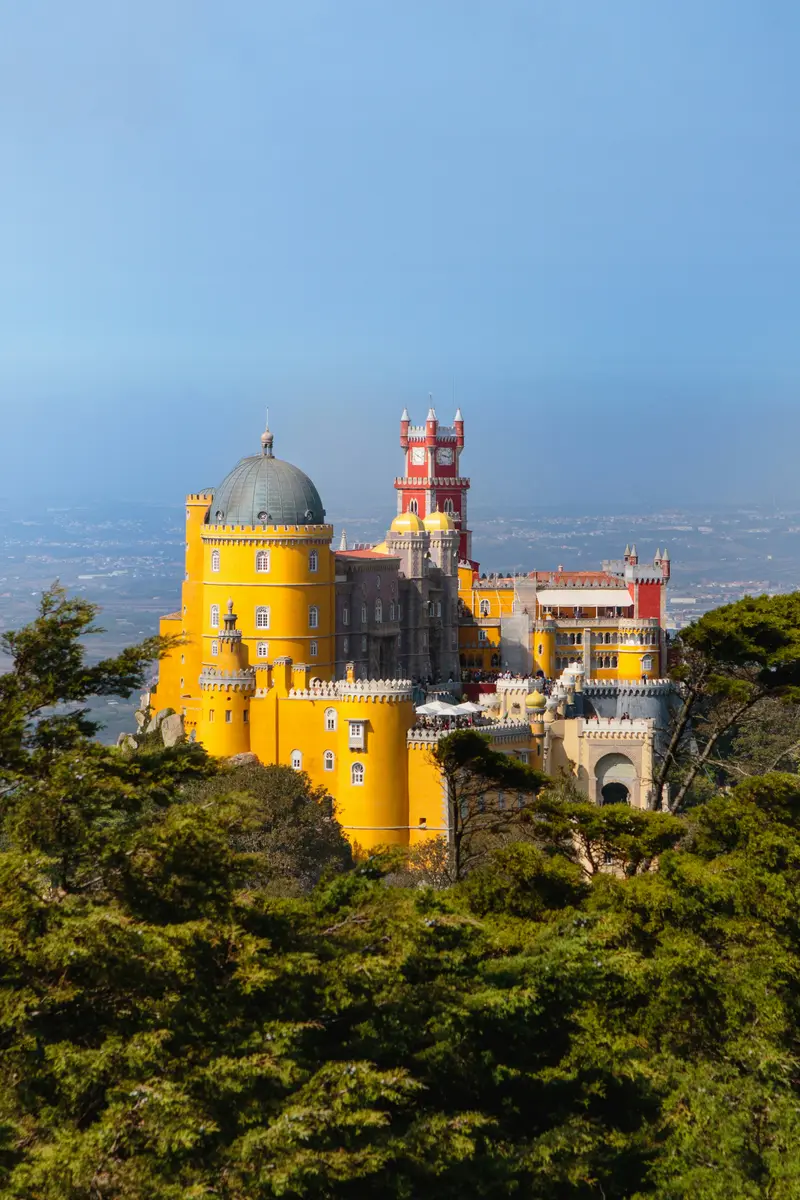
Le palais de Pena est l'œuvre fondatrice de l'architecture romantique revivaliste portugaise et l'un des tout premiers palais romantiques d'Europe, devançant d'environ trois décennies Neuschwanstein, le château de Louis II de Bavière. Plutôt que de suivre un seul style, il en mêle délibérément quatre : créneaux néogothiques et arcs brisés ; moulures néo-manuélines en corde torsadée et motifs maritimes faisant écho à l'âge d'or des découvertes portugaises du XVIe siècle ; arcs outrepassés néo-islamiques, coupoles couvertes d'azulejos et voûtes peintes imitant le stuc mauresque ; et décors intérieurs néo-Renaissance. Cette combinaison éclectique était une affirmation consciente du roi Ferdinand II sur l'identité nationale portugaise, non une indécision architecturale. Les deux couleurs dominantes du bâtiment font partie du dessein : l'aile manuéline rouge enveloppe le cloître subsistant de l'ancien monastère, tandis que l'aile jaune canari abrite les appartements royaux plus récents. Le résultat est une silhouette de conte de fées unique, faite de tours, de coupoles et de créneaux, qui ne ressemble à rien d'autre au Portugal et figure parmi les bâtiments les plus photographiés d'Europe.
À quelle heure dois-je arriver ?
10 à 15 minutes avant l'heure de votre créneau. Vous pouvez arriver plus tôt, mais vous ne serez pas admis avant l'heure prévue — et les horaires sont stricts, donc si vous arrivez en retard, vous risquez de devoir attendre le prochain créneau disponible.
Comment le Palácio da Pena se compare-t-il au Castelo dos Mouros situé sur la crête voisine ?
Les deux occupent des crêtes voisines, à environ 20 minutes de marche l'un de l'autre, et se complètent plutôt qu'ils ne rivalisent. Le Castelo dos Mouros, ou château maure, est un fort de colline des VIIIe-IXe siècles partiellement restauré, le site le plus ancien d'environ un millénaire, et il repose entièrement sur des remparts praticables et de vastes panoramas sur Sintra et l'Atlantique ; il n'a aucune salle intérieure à visiter. Le palais de Pena, à l'inverse, est un palais romantique du XIXe siècle dont l'attrait tient aux couleurs saturées, à l'architecture revivaliste éclectique et à de riches intérieurs royaux conservés depuis le jour de la chute de la monarchie en 1910. Le château récompense une marche et une vue ; le palais de Pena récompense un regard lent sur les salles et le décor. Ils partagent une zone d'entrée commune et le même exploitant, et la plupart des visiteurs qui font les deux dans la même journée montent d'abord au château maure, quand les jambes sont fraîches, et terminent au palais de Pena, gardant le plus grand spectacle pour la fin.
Comment se rendre au Palais de Pena ?
Le Palais de Pena surplombe la ville de Sintra, à environ 30 kilomètres au nord-ouest de Lisbonne. L'accès le plus simple se fait en train : des liaisons fréquentes relient la gare de Rossio à Lisbonne à Sintra en 40 minutes environ. Depuis la gare de Sintra, le bus touristique circulaire 434 gravit la colline jusqu'au palais, en marquant un arrêt au Château des Maures sur le trajet. Le trajet en bus dure environ 15 minutes, bien que les files d'attente puissent être longues en haute saison. Les visiteurs les plus énergiques pourront opter pour une montée à pied à travers le Parc de Pena, une ascension soutenue de 30 à 40 minutes depuis le centre historique. En voiture, Pena se trouve à environ 40 minutes de Lisbonne, mais le stationnement près de l'entrée est très limité et les routes étroites à flanc de colline sont vite embouteillées en été. Depuis la grille principale, une marche en montée ou un court trajet en navette est nécessaire pour atteindre les portes du palais.
Est-ce adapté aux enfants ?
Oui — les enfants adorent généralement l'architecture de conte de fées, les donjons et les canons. Les poussettes ont du mal à rouler sur les pavés ; une navette au départ de l'entrée est donc utile.
Et s'il pleuvait ?
Pena est ouvert par tous les temps et la plupart des visiteurs trouvent que les journées brumeuses ou pluvieuses ont un charme particulier. Aucun remboursement n'est accordé pour des raisons météorologiques. Si une fermeture exceptionnelle est annoncée par l'exploitant, nous vous remboursons intégralement.
Existe-t-il une offre de restauration au Palácio Nacional da Pena ?
Oui. Un café et un restaurant sont situés au niveau du palais, près de l'entrée, et un second café plus modeste se trouve dans le parc bas. Ces établissements peuvent être très fréquentés aux heures de déjeuner et ne constituent pas des destinations gastronomiques. De nombreux visiteurs préfèrent se restaurer avant ou après leur visite au Palácio Nacional da Pena dans le centre de Sintra, qui offre une concentration plus dense de restaurants. Des fontaines sont accessibles dans le parc ; emporter une gourde réutilisable est judicieux.
Existe-t-il une tenue exigée au Palácio Nacional da Pena ?
Aucune tenue formelle n'est imposée. L'aspect pratique prime sur l'élégance : privilégiez des chaussures fermées avec semelle antidérapante pour les allées pavées de granit, une couche supplémentaire pour compenser la différence de température par rapport à Lisbonne, ainsi qu'un coupe-vent léger imperméable pour les brumes d'octobre à mai. La chapelle du palais — toujours consacrée — demande par courtoisie que les épaules soient couvertes.
Le créneau horaire pour la visite concerne-t-il l'ensemble de la visite ou uniquement l'intérieur du palais ?
Uniquement l'intérieur du palais. Le parc est ouvert à toute personne munie d'un billet incluant le parc tout au long de la journée. Votre créneau horaire ne détermine que le moment où vous pouvez franchir la porte du palais — généralement une fenêtre de 30 minutes. Une fois à l'intérieur, vous pouvez prendre tout le temps raisonnablement nécessaire sur le parcours à sens unique.
Le Palácio da Pena a-t-il réellement été habité ?
Oui. Le palais de Pena était une résidence royale en activité, utilisée régulièrement par la famille royale portugaise depuis son achèvement en 1854 jusqu’à la fin de la monarchie en 1910. Le roi Ferdinand II, qui le construisit, l’utilisa comme retraite d’été, et il passa à son fils le roi Louis, à son petit-fils le roi Charles et à son arrière-petit-fils le roi Manuel II, le dernier roi du Portugal. Ce fut l’une des premières résidences royales portugaises équipées d’une ligne téléphonique fonctionnelle. Lorsque Manuel II s’enfuit en exil à bord du yacht royal le 5 octobre 1910 pendant la révolution républicaine, ses appartements privés au palais de Pena furent scellés peu après et préservés avec leurs meubles, livres et objets personnels d’origine, en grande partie tels qu’il les avait laissés. En vous promenant aujourd’hui, vous ne voyez pas une reconstitution muséale, mais les pièces qu’une famille royale de l’époque édouardienne utilisait vraiment, figées au moment de la chute de la monarchie, avec des ustensiles de cuisine en cuivre encore suspendus dans la cuisine.
Le palais de Pena est-il inscrit au patrimoine mondial de l'UNESCO ?
Oui. Pena constitue la pièce maîtresse du paysage culturel de Sintra, inscrit sur la liste du patrimoine mondial de l'UNESCO en 1995. Cette distinction couvre l'ensemble du paysage des collines de Sintra et plusieurs monuments qui le composent — Pena, le château des Maures, le palais national de Sintra dans la ville, les jardins de Monserrate et le couvent dos Capuchos — formant un paysage culturel cohérent de l'époque romantique.
Le Palais de Pena vaut-il la visite si je ne dispose que d'une journée à Sintra ?
Oui. Le palais de Pena est l'attraction la plus singulière du Paysage culturel de Sintra et celle que les visiteurs d'un jour regrettent le plus d'avoir manquée. Perché sur la crête boisée la plus haute de la Serra de Sintra, sa tour de l'horloge jaune canari, son aile manuéline vermillon et ses créneaux mauresques en font l'un des bâtiments les plus photographiés d'Europe, et l'intérieur conserve les appartements royaux presque exactement tels que la famille royale portugaise les a laissés à la chute de la monarchie en octobre 1910. Si vous n'avez qu'un jour et qu'un site, choisissez le palais de Pena et prévoyez au moins quatre heures, train et bus depuis la ville de Sintra compris. Si le temps permet une deuxième halte, associez-le à Quinta da Regaleira pour ses jardins ésotériques et son Puits Initiatique, ou au château maure du VIIIe siècle voisin pour ses remparts et ses vues sur l'Atlantique, même si tenter les trois en une seule journée laisse la plupart des visiteurs pressés.
Le palais est-il accessible aux personnes en fauteuil roulant ?
En partie. Le parc et les pièces du rez-de-chaussée sont accessibles par navette et par des rampes d'accès. Les appartements royaux situés aux étages supérieurs ne sont accessibles que par des escaliers et ne disposent pas d'ascenseur.
Le service de conciergerie vaut-il la peine par rapport à un achat direct auprès de l'exploitant ?
Tout dépend de ce à quoi vous accordez de la valeur. Un service comme le nôtre ajoute une sélection de créneaux sur mesure (la bonne fenêtre pour l'intérieur selon votre préférence de lumière et d'affluence), une préparation avant le voyage, un point de contact dans votre langue pour les modifications, et un regroupement avec les transferts ou d'autres attractions de Sintra. Si vous souhaitez la version magique de la visite, avec quelqu'un qui maîtrise les détails opérationnels, c'est pour cela que nous existons.
Le site Pena Palace est-il accessible aux personnes en fauteuil roulant ?
Partiellement. Parques de Sintra exploite une navette interne de la porte inférieure du parc au parvis du palais, accessible en fauteuil roulant. Les terrasses extérieures autour du palais sont en grande partie accessibles. L'itinéraire intérieur à travers les salles comprend plusieurs volées d'escaliers et des couloirs étroits et n'est pas entièrement accessible en fauteuil roulant. Le Chalet de la Comtesse d'Edla et la Haute Croix impliquent des sentiers non pavés et des pentes. Parques de Sintra publie une page d'accessibilité spécifique sur son site, que nous recommandons à tout visiteur à mobilité réduite de consulter avant de réserver.
Les chiens sont-ils admis au Palácio Nacional da Pena ?
Les petits chiens tenus en laisse sont autorisés dans le parc ; ils ne sont pas admis à l'intérieur du palais. Les visiteurs accompagnés de chiens d'assistance sont accueillis dans l'ensemble du site. Les gamelles d'eau ne sont pas disposées en permanence sur le parcours — prévoyez la vôtre si vous visitez en période estivale.
Où se trouve exactement la Cruz Alta et vaut-elle le détour ?
La Cruz Alta marque l'affleurement granitique au point culminant de la Serra de Sintra, à 528 mètres d'altitude, accessible après environ 20 minutes de marche en montée vers le sud-est du palais à travers le parc supérieur. Le sentier, irrégulier et granitique, n'est pas praticable en poussette ni en fauteuil roulant. Le détour vaut pleinement le déplacement pour la vue panoramique — l'Atlantique, le Cabo da Roca, le Tage et le palais lui-même contemplé dans son plein contexte paysager — et constitue le meilleur point de vue photographique de l'ensemble du domaine.
Puis-je accéder à Pena Palace en voiture ?
Non, pas jusqu'au palais lui-même. La route supérieure de la Serra est fermée aux véhicules privés depuis 2022. Les visiteurs indépendants se garent sur l'un des parkings du bas de la montagne et utilisent la navette de Parques de Sintra, le bus 434 hop-on, ou un transfert pré-arrangé pour atteindre la porte du palais. Les transferts privés peuvent déposer et récupérer les passagers à l'entrée principale même si la circulation générale ne le peut pas.
Puis-je entrer avec une poussette au Palácio Nacional da Pena ?
Dans le parc, oui, bien que les sentiers soient raides à certains endroits. Dans l'intérieur du palais, en pratique non — l'itinéraire à sens unique comprend plusieurs volées d'escaliers et des passages étroits. Parques de Sintra fournit une zone de stationnement pour poussettes près de la porte du palais. Un porte-bébé souple est le bon choix pour l'intérieur avec des nourrissons.
Puis-je modifier la date ou l'heure ?
Une fois réservés, les créneaux horaires ne sont ni transférables ni remboursables. Si vous devez modifier votre réservation, contactez-nous à l'adresse bookings@palaciopena.com. Nous ferons notre possible pour vous aider, mais nous ne pouvons pas garantir un nouveau créneau horaire, en particulier en haute saison.
Puis-je prendre des photographies à l'intérieur du Palácio Nacional da Pena ?
Oui, dans la plupart des salles, sans flash. Un nombre restreint de pièces — généralement celles abritant des textiles délicats ou des décors peints récemment restaurés — interdisent totalement la photographie ; une signalétique l'indique à l'entrée de ces espaces. Les trépieds ne sont pas autorisés à l'intérieur. Les drones sont interdits dans l'ensemble de la Paisagem Cultural de Sintra, parc inclus.
Puis-je visiter l'intérieur de la chapelle de Pena ?
Oui, avec le billet Palais + Parc. La chapelle est la partie la plus ancienne du complexe — l'édifice original du XVIe siècle dédié à Nossa Senhora da Pena qui a survécu au tremblement de terre de 1755 — et se découvre au début du parcours intérieur à sens unique. Elle conserve son retable d'albâtre d'origine et demeure consacrée ; l'exploitant demande aux visiteurs de parler à voix basse et de garder les épaules couvertes.
Puis-je visiter le Palais de Pena sans accéder aux appartements ?
Oui. Le billet Parc uniquement vous donne accès aux jardins et aux terrasses extérieures du palais — notamment tous les points de vue privilégiés — mais pas aux salons intérieurs. C'est le choix idéal si vous privilégiez la photographie et les paysages plutôt que les appartements et l'histoire royale. Nous orientons par défaut les visiteurs découvrant les lieux vers le billet Palais + Parc, les intérieurs étant tout à fait remarquables ; consultez la section billetterie ci-dessus.
Qu'est-ce que le Palais de Pena ?
Le Palais de Pena (Palácio Nacional da Pena) est un chef-d'œuvre romantique du XIXe siècle, juché sur une colline boisée dominant la ville de Sintra, au Portugal. Édifié pour le roi Ferdinand II à partir des années 1840 sur les ruines d'un monastère hiéronymite dévasté par le tremblement de terre de Lisbonne de 1755, il fut en grande partie achevé en 1854. Le palais est célèbre pour ses couleurs éclatantes et son architecture délibérément éclectique, mêlant des éléments néo-gothiques, néo-manuélins, néo-mauresques et néo-Renaissance en une silhouette de conte de fées. Parmi ses joyaux figurent les terrasses rouges et jaunes offrant des panoramas à couper le souffle sur la Serra de Sintra, l'allégorique portail du Triton, le cloître préservé et les salles de l'ancien monastère, ainsi que les somptueux intérieurs royaux. Le palais se dresse au cœur du vaste parc forestier de Pena et fait partie intégrante du Paysage culturel de Sintra, classé au patrimoine mondial de l'UNESCO, et compte parmi les Sept Merveilles du Portugal.
Qu'est-ce qui est inclus dans le billet coupe-file ?
Entrée à l'intérieur du Palais de Pena et au parc environnant de 200 hectares, avec accès prioritaire à l'entrée du palais. Votre créneau de 30 minutes est réservé avant votre arrivée.
Quand le palais de Pena a-t-il été construit et par qui ?
Le palais de Pena a été construit entre 1842 et 1854 pour le roi Ferdinand II de Saxe-Cobourg-Gotha, époux d’origine allemande de la reine Marie II du Portugal et cousin de la reine Victoria et du prince Albert de Grande-Bretagne. Ferdinand acheta le sommet de la colline en 1838 et confia à l’ingénieur des mines et architecte amateur allemand, le baron Wilhelm Ludwig von Eschwege, le soin de le transformer en résidence d’été romantique pour la famille royale. Le palais s’éleva sur les ruines d’un monastère hiéronymite du XVIe siècle fondé par le roi Manuel Ier et réduit en décombres par le grand tremblement de terre de Lisbonne de 1755 ; la chapelle et le cloître manuélin du monastère survécurent et furent délibérément préservés dans le nouveau bâtiment. Ferdinand supervisa lui-même la palette de couleurs vives, le mélange éclectique de styles revivalistes et le parc environnant. Après sa mort en 1885, l’État portugais acquit le palais de Pena en 1889, et il devint monument national après la révolution républicaine de 1910.
Que se passe-t-il si je manque mon créneau d'entrée à l'intérieur du Pena Palace ?
Le personnel de Parques de Sintra essaiera normalement d'admettre les retardataires dans le prochain créneau disponible si la capacité le permet, mais en haute saison — globalement d'avril à octobre et tout jour de croisière à Lisbonne — c'est souvent impossible. Arrivez à la porte du palais cinq à dix minutes avant l'ouverture de votre créneau pour être sûr. Si vous avez réservé par l'intermédiaire d'un service de conciergerie, contactez-les dès que vous réalisez que vous serez en retard afin qu'ils puissent coordonner.
Quel billet pour le palais de Pena dois-je acheter — Palais et Parc, ou Parc seulement ?
Pour presque tous les visiteurs qui viennent pour la première fois, le billet Palais + Parc est le bon choix. Le billet parc uniquement — vendu directement par Parques de Sintra à un prix inférieur — couvre les 200 hectares de jardins, les terrasses extérieures, les lacs de la vallée et essentiellement toutes les photographies extérieures que vous avez vues de Pena. Il mérite considération si vous êtes un visiteur qui revient et qui s'intéresse au paysage plutôt qu'aux salles. Pour tous les autres, l'intérieur est la raison pour laquelle Pena n'est pas un château portugais photogénique de plus : les salles royales furent scellées le jour où la monarchie tomba en octobre 1910 et demeurent exactement telles que la famille royale les a laissées — une résidence en activité figée au milieu de l'après-midi, en pleine révolution. Pena Palace Tickets réserve Palais + Parc avec accès prioritaire coupe-file et accompagnement dans votre langue inclus dans le prix. Nous ne proposons pas d'option parc uniquement ; si c'est ce qu'il vous faut, réservez directement sur le site web ou au guichet de Parques de Sintra.
Quelle durée prévoir pour la visite du Palais de Pena ?
Prévoyez au moins trois heures pour une visite du Palais et du Parc de Pena, et quatre à cinq heures si vous voulez tout voir sans vous presser. Une répartition réaliste : 60 à 75 minutes à l'intérieur du palais, y compris la courte attente à la porte d'entrée à horaire réservé et le circuit à sens unique à travers les salles royales ; environ 90 minutes à flâner dans le parc de 200 hectares ; et une marge pour la montée raide de 600 mètres, ou la navette, depuis l'entrée basse jusqu'à l'esplanade du palais. Ajouter le Chalet de la Comtesse d'Edla dans la partie ouest du parc et les 20 minutes de montée jusqu'au belvédère de la Croix Haute pousse la visite vers quatre ou cinq heures. Les familles avec de jeunes enfants devraient prévoir cinq heures pleines et utiliser la navette intérieure pour épargner les petites jambes. Parce que le parc mérite vraiment une demi-journée à lui seul, se précipiter au Palais de Pena est le principal regret que rapportent la plupart des visiteurs.
Quelle est l'affluence à Pena ?
Très forte. Pena accueille plusieurs millions de visiteurs par an et les samedis d'été, le parc haut peut sembler saturé entre 11h30 et 15h00. Les solutions éprouvées consistent à réserver un créneau intérieur au premier horaire (09h30–10h00 dans la plupart des saisons), privilégier les jours de semaine, visiter hors saison entre novembre et février (quand la brume est la plus présente et le parc au plus calme), et éviter les jours où plusieurs paquebots de croisière sont amarrés à Lisbonne. Notre page /guides/best-time-to-visit/ détaille les flux liés aux escales de croisières.
Quelle est la durée d'une visite typique ?
Prévoyez 3 à 4 heures au total : 45 à 60 minutes à l'intérieur du palais, plus de 90 minutes dans le parc, sans compter le trajet aller-retour jusqu'à l'entrée.
Quelle est votre politique de remboursement ?
Les billets sont émis pour une date précise et ne sont pas transférables une fois émis. Si vos projets changent, répondez à votre email de confirmation au moins 48 heures avant votre date et nous reprogrammerons votre visite sur tout créneau disponible dans le calendrier de l'exploitant.
Quels sont les horaires d'ouverture du Palais de Pena ?
Parques de Sintra ajuste ses horaires d'ouverture selon les saisons et nous ne les citons jamais dans nos textes pour éviter qu'ils ne deviennent obsolètes. Globalement, le parc ouvre entre 09h00 et 09h30 et ferme entre 18h30 et 19h30 selon la saison, l'intérieur du palais étant accessible sur une fenêtre légèrement plus restreinte à l'intérieur de ces horaires. Vérifiez toujours les horaires en temps réel sur le calendrier publié par l'opérateur pour votre date précise — ils changent autour des changements d'heure et des jours fériés.
Qui est la comtesse d'Edla et pourquoi possède-t-elle un chalet ?
Elise Hensler était une chanteuse d'opéra née en Amérique et élevée en Suisse, que Ferdinand II rencontra après la mort de la reine Maria II. Ils se marièrent en 1869 et elle fut créée comtesse d'Edla. Ferdinand lui fit construire un chalet de style suisse dans la partie ouest du parc de Pena comme retraite privée, délibérément distincte du palais principal. Il fut gravement endommagé par un incendie en 1999 et rouvert en 2011 après restauration. Il dispose de son propre créneau horaire et est inclus dans les billets combinés Pena.


 7 min
7 min  7 min
7 min  7 min
7 min  7 min
7 min